Ask five people in the translation industry what is multilingual DTP, and you will get five overlapping answers – layout, typesetting, formatting, “making the translated file look right”. They are all partly correct. Multilingual DTP (desktop publishing) is the stage of a translation project where translated text is rebuilt into the original design – so a brochure translated into German still looks like the brochure, not like a Word file with the wrong fonts. This guide explains what multilingual DTP means in practice, why translated text reliably breaks layouts, where the work sits in a translation workflow, and when you actually need it.
What Multilingual DTP Actually Means
DTP stands for desktop publishing – the craft of arranging text, images, and design elements into finished page layouts using tools like Adobe InDesign, Illustrator, or even Word and PowerPoint. Add “multilingual” and the job changes: the layout is not being created once, but rebuilt across language versions of the same document, each with different text lengths, different scripts, and sometimes a different reading direction.
So what is multilingual DTP in one sentence? It is the production work that takes a finished design plus a finished translation and delivers language versions that match the source – same structure, same brand, same print-ready quality – with every line break, table, and caption sitting where a reader of that language expects it. In the translation industry this step is also called post-translation DTP, localization DTP, or foreign-language typesetting; the terms describe the same work.
Why Translated Text Breaks the Original Layout
If translation only changed the words, DTP would be a copy-paste job. It is not, because four things change at once:
- Text length. Translations rarely occupy the same space as the source. German and Finnish routinely run longer than English; Chinese often runs shorter. A text box designed for the English sentence overflows, or leaves awkward gaps, in every other language.
- Scripts and fonts. The brand font of the source document often has no glyphs for Cyrillic, Greek, Arabic, or CJK characters. Someone has to choose a substitute that matches the design intent – and apply it consistently across hundreds of text frames.
- Reading direction. Arabic, Hebrew, and Persian read right to left, which mirrors the entire page logic: alignment, margins, image placement, table order, even the position of page numbers. W3C’s overview of script directions shows how varied this landscape is.
- Typographic rules. Hyphenation, punctuation spacing, quotation marks, number formats, and line-break rules differ by language. A layout that ignores them looks subtly – or obviously – wrong to a native reader.
This is why “just replace the text” produces documents that feel broken even when every word is correct. The design has to be re-fitted to the language, not the language squeezed into the design.
Where DTP Sits in the Translation Workflow
Multilingual DTP is a production stage, and it has a fixed place in the pipeline:
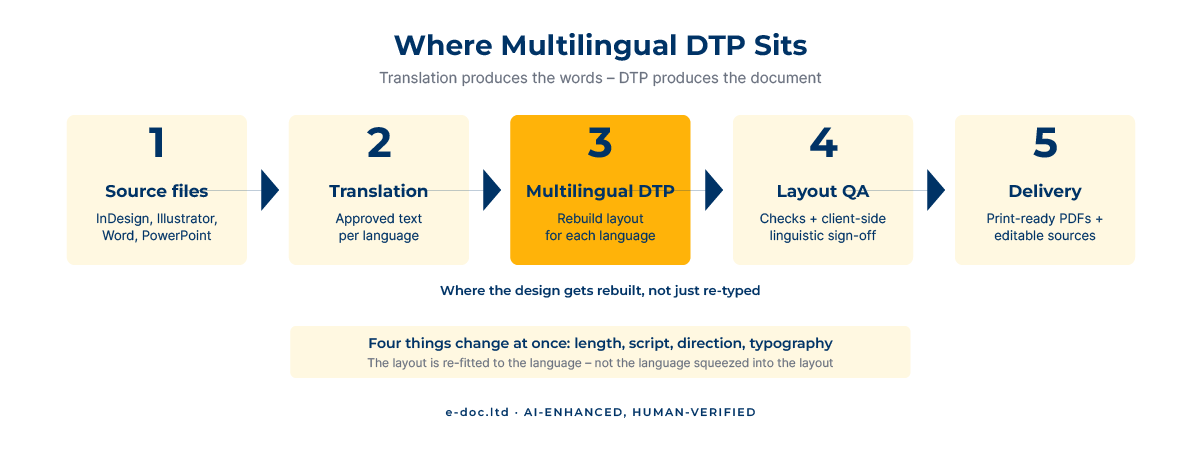
It starts from two inputs: the original design files (an InDesign package, an Illustrator artboard, a Word or PowerPoint source) and the approved translation. If the source only exists as a scan or a flat PDF, an extra step comes first – recovering editable text, which is what OCR does – and often a rebuild of the layout itself. From there, the DTP specialist flows the translated text into the design, fixes everything the new language broke, and prepares final files for print or digital use.
What a DTP Specialist Actually Does
The visible output is “the same document in another language”. The invisible work behind it typically includes:
- Text placement and reflow – flowing translated copy into every frame and restoring the intended hierarchy of headings, body text, captions, and callouts.
- Resizing and re-fitting – adjusting boxes, columns, and spacing so longer or shorter text still reads naturally, without shrinking type to unreadable sizes.
- Font management – selecting and applying substitutes where the brand font lacks the needed script, and keeping the substitution consistent document-wide.
- Tables, charts, and graphics – rebuilding tables that expanded, replacing embedded text in images, and relinking assets that broke during the language swap.
- Language-aware detail work – hyphenation settings, punctuation conventions, list and number formats appropriate to the target language.
- Output preparation – print-ready PDFs with correct bleeds and color settings, or clean digital deliverables, plus the editable source files back to the client.
On a 40-page catalog in eight languages, this is hundreds of small decisions per language – which is why multilingual DTP is quoted as real production work, not an afterthought to translation.
Single-Language DTP vs Multilingual DTP
Classic DTP builds one document well. Multilingual DTP manages consistency across many parallel versions of the same document – and that difference drives the workflow. Language versions are produced against a master layout, so a fix discovered in the French edition gets applied to all editions. Scripts outside the team’s working languages are handled through a disciplined split that the industry treats as standard: the client supplies the original plus the approved translation (bilingual tables or paired files), the DTP team owns layout and typesetting, and a reviewer on the client side gives the final linguistic sign-off on the assembled pages. Production and language checking are separate responsibilities – that separation is what keeps quality honest across 5, 10, or 20 language editions.
Need translated documents rebuilt to match the original design?
We provide multilingual desktop publishing across 50+ languages – InDesign, Illustrator, Word, and PowerPoint layouts returned print-ready, with the same structure and brand as your source.
Who Needs Multilingual DTP
Three groups run into this work constantly:
- Translation agencies and LSPs. Clients hand them InDesign packages and expect InDesign packages back. Agencies without an in-house layout team outsource this stage – our work with translation agencies is built exactly around that handoff, including Trados packages and XLIFF round-trips.
- Corporate and marketing teams. Annual reports, product catalogs, and manuals that must stay on-brand across every market edition.
- Publishers and authors. Books and long-form publications moving between markets, where interior layout and typography carry as much weight as the words. A recent example from our own portfolio: a multilingual DTP localization project delivered as parallel language editions from one master design.
The common thread: the document’s appearance is part of the deliverable. If a plain text file would satisfy the end reader, DTP is unnecessary. If the layout carries the message, it is the difference between translated words and a finished document.
Frequently Asked Questions
What does DTP mean in translation?
In translation projects, DTP (desktop publishing) is the stage after translation where the translated text is placed back into the original design and the layout is repaired – text fitting, fonts, tables, images, and typographic details – so each language version matches the source document.
Is multilingual DTP the same as translation?
No. Translation produces the words; DTP produces the document. They are separate skills and usually separate specialists. A translator is rarely a layout professional, and a DTP specialist does not need to speak every language they typeset – the workflow is designed around that division.
What software is used for multilingual DTP?
Adobe InDesign is the industry workhorse for multi-page layouts, with Illustrator and Photoshop for graphics. Word and PowerPoint count too – a large share of real-world corporate documents live in Office formats and need the same language-aware layout care.
Why does translated text break the layout?
Because more than the words change: text length expands or shrinks, the target script may need different fonts, right-to-left languages mirror the page, and each language has its own line-break and punctuation rules. The original layout was designed around one language’s behavior.
Do right-to-left languages like Arabic need special DTP?
Yes. RTL layouts are mirrored, not just re-typed: alignment, margins, reading order of columns and tables, and image placement all flip. It is a structurally different layout job, and the final linguistic check of the assembled pages is normally confirmed by a reader of the language.
How is multilingual DTP priced?
Most commonly per page per language, adjusted for layout complexity (tables, graphics, script complexity) and the condition of the source files. Editable source files cost less to process than flat PDFs, which may need reconstruction first. A firm quote requires seeing a sample of the actual files.
So, what is multilingual DTP? It is the production discipline that turns approved translations into finished documents – the stage where text length, scripts, direction, and typographic rules get reconciled with the original design. Skip it, and correct translations ship inside broken layouts. Do it properly, and every language edition looks like it was designed in that language from the start.