Every translation project with a designed source hits the same moment: the translation is approved, the client expects the finished brochure, manual, or report back in its original form – and someone has to make that happen. That someone is doing post-translation DTP: the production stage that takes a design package plus approved translations and returns print-ready language editions. This guide walks through the workflow step by step – what comes in, what actually happens to the files, where projects get stuck, and what a translation agency or end client should prepare to make the whole thing fast.
Where Post-Translation DTP Starts: The Two Inputs
Post-translation DTP has exactly two prerequisites, and the quality of both decides the timeline:
- The original design files. Ideally a complete package – the layout document plus every font and linked image it uses. For InDesign, that means a proper package rather than a lone .indd file; Adobe’s packaging function exists precisely because a layout without its fonts and links is only half a file. Word and PowerPoint sources travel lighter but still need their fonts identified.
- The approved translation. Approved is the operative word: typesetting an unapproved draft means re-typesetting it after every round of linguistic edits. The translation arrives as a bilingual deliverable – a CAT-tool package, an XLIFF file, or a two-column table mapping each source segment to its target.
If the design source does not exist – the client has only a flat PDF or a scan – an extra reconstruction stage comes first, and the quote reflects it. That situation is common and solvable, but it is rebuilding, not re-flowing. (For the bigger picture of where this stage sits in a translation project, see our guide to what multilingual DTP is.)
The Post-Translation DTP Workflow – Step by Step
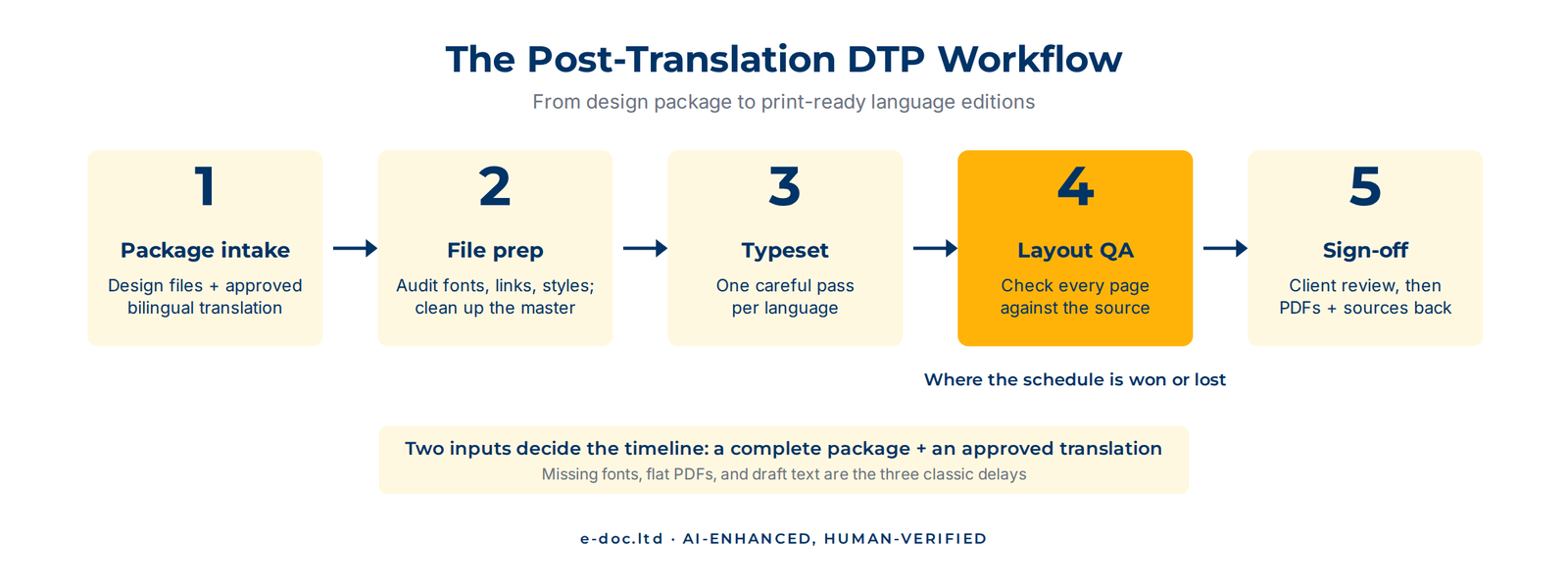
1. Package intake. We check the design package and translations on arrival: do the files open, are the fonts present, do the links resolve, does the translation cover every visible string – including the text buried in graphics, captions, headers, and footers that a word count often misses.
2. File preparation. We make the master document language-ready: we audit the styles, clean out stray local formatting, verify text frames and threading, and draw up a font plan for any script the brand font does not cover. This is quiet work that determines everything downstream – a clean master multiplies across every language edition, and so does a messy one.
3. Typesetting per language. The translated text flows into a copy of the master, and the language-specific repair begins: we fix overflow, adjust spacing and hyphenation settings, re-fit tables, swap in graphics with translated embedded text, and set the text direction for RTL editions. Each language gets its own pass – shortcuts at this stage are what produce broken language editions.
4. Layout QA. We check every page against the source: nothing missing, nothing duplicated, every segment in its mapped position, styles consistent, images correct, page counts matching where they must. For scripts outside our working languages, our QA confirms structural and mapping integrity, and the assembled pages then go to the client’s in-country reviewer for linguistic sign-off – the standard split between production and language responsibility.
5. Sign-off and delivery. We implement the reviewer’s comments, generate final print-ready PDFs with the agreed color and bleed settings, and return the editable sources to the client – the same kind of package that came in, now in every language.
What “File Prep” Hides – and Why It Predicts the Whole Project
Stage 2 looks like housekeeping and is actually diagnosis. A files audit at the start answers the questions that otherwise surface as mid-project surprises: which fonts are missing, which links are low-resolution copies of lost originals, which “one brochure” is actually three near-identical versions with undocumented differences, which text lives inside images and was never sent for translation. Surfacing all of this on the first day – with a written list back to the client – is the best early signal of whether a project ships on schedule.
Working With Agency Formats
For translation agencies, post-translation DTP is a handoff problem as much as a layout problem, so we adapt the workflow to the agency’s pipeline rather than the other way around: we process Trados and other CAT-tool packages round-trip, return XLIFF files in a form the TM accepts, and work from bilingual tables when that is what the project has. The goal is that outsourced DTP behaves like an internal studio – files return in the format the workflow expects, with no learning curve on the agency side. That handoff discipline is the core of how we work with translation agencies.
Need a reliable post-translation DTP partner?
We take design packages and approved translations and return print-ready, on-brand language editions across 50+ languages – Trados packages and XLIFF round-trips included.
What Slows Post-Translation Projects Down
The honest list, from experience – every item avoidable with one email before the project starts:
- Missing fonts. The most common delay. A package without its fonts triggers a licensing-and-substitution conversation that should have happened on day one.
- A flat PDF instead of the source. Reconstruction is a real stage with real hours; discovering it mid-quote resets the timeline.
- Unapproved translations. Typesetting a draft means typesetting it twice. Linguistic edits after layout cost more than before it.
- Untranslated embedded text. Charts, diagrams, and screenshots carry text that word counts skip – it surfaces at QA as “why is this still in English”.
- Per-language scope drift. “While you are in the German edition, could you also update…” – small per-language changes multiply across editions and quietly detach them from the master.
Frequently Asked Questions
What is post-translation DTP?
Post-translation DTP is the production stage after translation: a DTP specialist places the approved translated text into the original design, repairs the layout for each language – text fit, fonts, tables, graphics, direction – and delivers print-ready files plus editable sources.
What files do you need to start?
Two things: the original design package (layout file plus fonts and linked images – for InDesign, a proper package) and the approved translation as a bilingual deliverable (CAT-tool package, XLIFF, or a two-column source-target table). If only a flat PDF exists, reconstruction comes first, and we quote it separately.
Can you work directly with Trados packages and XLIFF?
Yes. We process agency formats round-trip and return packages in the form the translation-memory workflow expects, so outsourced DTP slots into the agency pipeline without extra conversion steps on the agency side.
Why approve the translation before typesetting?
Because every linguistic edit after layout is a layout edit too. Typesetting a draft means repeating overflow fixes, line-break adjustments, and table refits after each review round. Approving the text first keeps DTP a single pass per language instead of several.
How do you check layout quality in languages you do not read?
Production QA verifies structure and mapping against the bilingual source: every segment present, in position, correctly styled, nothing duplicated or missing. A reader of the language on the client side then gives the final linguistic confirmation of the assembled pages – the standard division of responsibility in multilingual production.
How long does post-translation DTP take?
It depends on page count, layout complexity, number of languages, and source-file condition – a clean package moves much faster than a reconstruction job. Send the actual files and the language list, and we reply with a firm timeline and quote within one business day.
Post-translation DTP is a predictable, checklist-driven workflow when the two inputs are right: a complete design package and an approved translation. Everything that makes these projects painful – missing fonts, flat PDFs, draft text, embedded strings – is visible in the first hour of a proper intake. Get the intake right, and the rest is disciplined production.